
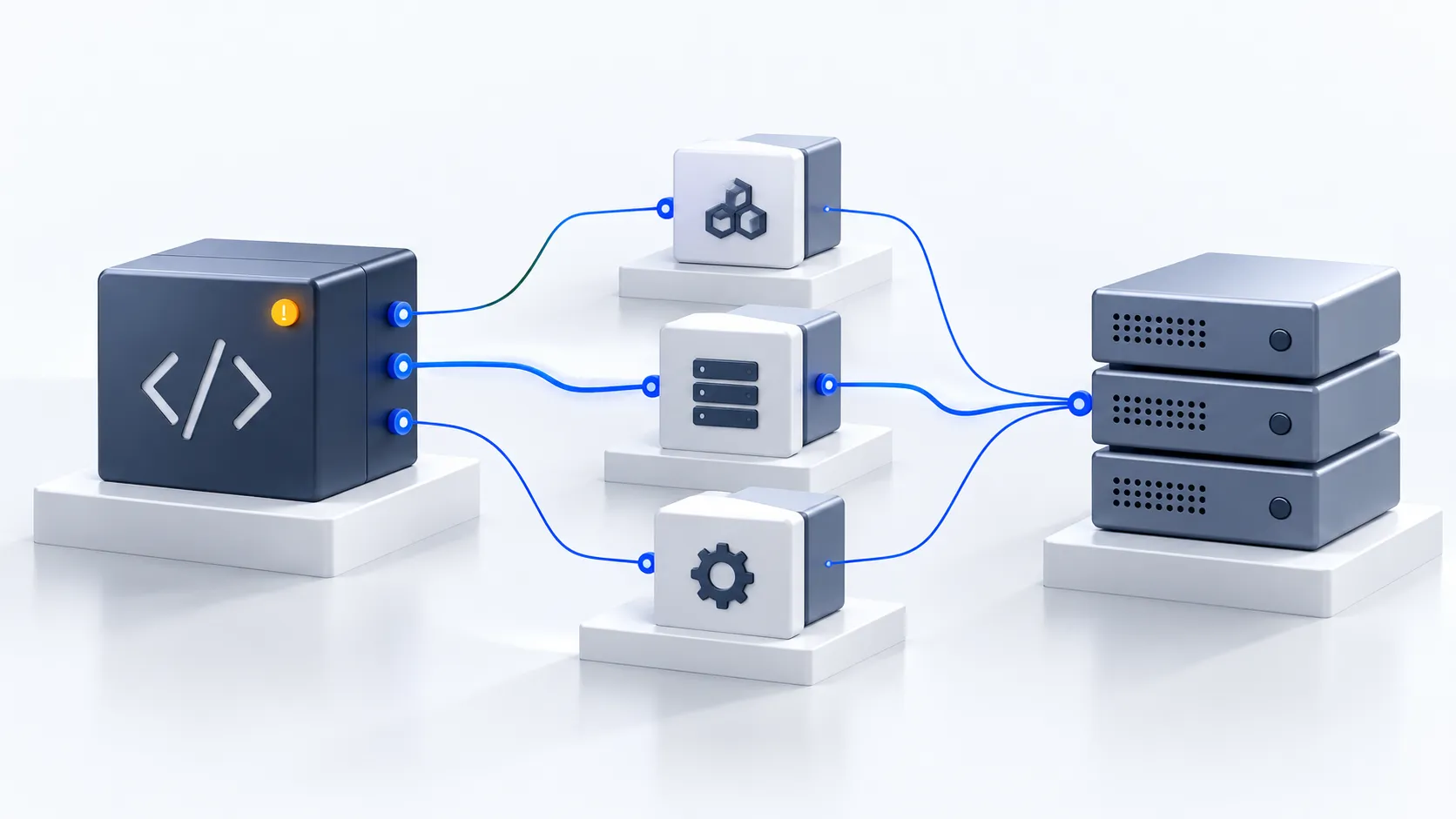
This article is part of Qinsight’s cryptographic posture management use case series, connecting five security outcomes with practical operational workflows.
In brief
- A library name in an inventory is a starting point. The response needs the exact build, the advisory's conditions, and the workloads and services where that build runs.
- Keep a component match, a deployed instance, an applicable condition and a verified remediation as separate findings rather than collapsing them into one alert.
- Verify that the corrected artifact reached every in-scope workload, including the scale-out templates and recovery images that can recreate the affected build.
A vulnerability in a widely used cryptographic library can generate a large list of possible matches. Security leaders need to know which business services require attention. Architects need to establish which builds and deployed workloads contain the relevant code, how it is used and what must change.
The challenge is that a library name can appear in several contexts: an operating-system package, an application bundle, a container image, a statically linked binary or a supplier’s product. Those records do not all describe the same deployed component.
Cryptographic posture management adds useful context when it connects software evidence to cryptographic functions and business services. The goal is a traceable assessment that supports remediation decisions and preserves the reasons behind them.
Turn the advisory into an assessment boundary
Start with the vendor’s technical advisory. Record the affected versions or builds, relevant functions, configuration conditions, supported fixes and any information about exploitation. Common Vulnerabilities and Exposures, or CVE, identifiers provide a reference, but the identifier alone does not describe the conditions in a particular environment.
A historical OpenSSL advisory provides a useful example. The November 1, 2022 advisory for CVE-2022-3602 and CVE-2022-3786 affected OpenSSL 3.0.0 through 3.0.6 and identified fixes in 3.0.7. The issues involved certificate verification. Relevant paths included clients connecting to a malicious server and servers requesting client authentication, subject to the advisory’s certificate-validation conditions.
That example shows why an assessment needs both component identity and application behavior. It is a historical case, not a recommendation to deploy that release today. Current remediation should follow the relevant vendor’s supported guidance.
Write the assessment questions down before interpreting the inventory. This helps different teams use the same criteria and makes later changes in advisory guidance easier to incorporate.
Identify the component that was actually shipped
A software bill of materials, or SBOM, can identify a library included in a build. Package records, image manifests and supplier statements can add more evidence. A cryptographic bill of materials, or CBOM, can describe the cryptographic assets and relationships within the defined scope.
The identities must be precise enough to compare. Record the application version, package origin, immutable image digest where available and build identifier. A container tag can move; a library filename may remain unchanged across releases. Vendor-maintained packages may include backported fixes that cannot be assessed from the upstream version string alone.
Also account for multiple copies. Updating the host’s package may leave an application’s bundled library unchanged. A rebuilt image may coexist with running workloads created from its predecessor. Static linking can make a library part of the executable rather than a separately replaceable package.
A TLS scan can establish aspects of an endpoint’s negotiated behavior. It generally cannot prove the exact cryptographic library build behind that endpoint. Keep software identity tied to evidence that can support it.
Connect presence, deployment and affected behavior
Consider an illustrative file-transfer service. Its build inventory lists an affected library. The same component appears in a processing worker and a separate administration tool. One runs continuously in production; the other is used only during maintenance. Their assessment and remediation paths may differ.
Begin by locating the deployed instances and owners. Then establish whether the relevant operation and configuration are present. Application evidence, runtime inspection, vendor analysis and targeted testing can contribute, depending on the product and the vulnerability.
| Assessment stage | What it establishes | What remains to check |
|---|---|---|
| Component match | A record identifies a potentially affected library or build. | Identity accuracy, vendor fixes and deployment. |
| Deployed instance | The relevant build is associated with a workload. | Current execution and affected functionality. |
| Applicable conditions | Evidence supports the advisory’s relevant conditions. | Exposure, mitigations and remediation priority. |
| Verified remediation | The intended replacement is deployed and checked. | Remaining instances, exceptions and future redeployment. |
Missing runtime evidence should remain an unresolved assessment item. It is not sufficient grounds to conclude that the vulnerable code cannot execute. Conversely, a dependency association alone does not prove that an attacker can reach the vulnerable function.
Prioritize the services and the work
Security leaders need an assessment that explains why one service is addressed first. Consider the advisory’s severity and exploitation information, the service’s exposure and business criticality, the relevant configuration and the strength of the evidence.
Remediation planning introduces further constraints. An internally built application may be rebuilt quickly. A supplier appliance may require a supported release and a maintenance window. A mitigation may reduce exposure temporarily while leaving an upgrade outstanding.
Assign those decisions to the service and component owners. Record the chosen action, target date, verification method and any exception. If the team concludes that a product is not affected, retain the specific justification and the product version to which it applies.
Vulnerability Exploitability eXchange, or VEX, provides a way to communicate vulnerability applicability in product context. Such a statement is useful evidence when its scope, author and rationale match the deployed product. It does not remove the need to confirm which product is actually running.
Build a CBOM that supports the investigation
For the affected application, create a CBOM linked to the software build and the relevant cryptographic implementations. Record the library identity, available algorithm or protocol relationships and the evidence supporting those associations.
Connect the artifact to the deployed workloads in the operational inventory. Include the environment, observation time and service owner in the appropriate records. A library that implements an algorithm is not proof that the application invokes that algorithm in production; preserve that distinction.
The CycloneDX CBOM model provides a structured way to represent cryptographic assets and their relationships to software components. Deployment context and the organization’s incident or remediation decisions can be linked alongside that representation.
Our article on CBOMs and cryptographic inventories explains the complementary roles. During a library vulnerability response, the build artifact helps identify what was delivered, while the maintained inventory helps identify where the relevant build is present.
Verify the deployed replacement
A successful build is an intermediate result. Confirm that the corrected artifact has reached the in-scope workloads and that the relevant processes are using the intended software. A package update may require a service restart or a replacement workload before the change takes effect.
Check scale-out templates, deployment manifests, rollback artifacts and recovery images. Otherwise, an ordinary operational action can recreate an affected instance after the ticket is closed. Preserve the old component’s identity in history while recording the verified replacement.
Functional tests should cover the cryptographic paths the application needs, including relevant client authentication or certificate validation behavior. Record any unavailable evidence and assign the remaining validation. This creates a completion criterion that both security and operations can assess.
How Atlas adds cryptographic context
Atlas helps organize cryptographic observations and the available relationships to applications, workloads and business services. For a library advisory, that context can help teams investigate which component records belong to which deployments and which owners need to respond.
The assessment still relies on the advisory, accurate software evidence and the application’s behavior. Atlas’s role is to make the cryptographic estate and its evidence easier to examine, with conclusions bounded by the discovery methods and integrations in scope.
For a pilot, select one application that has both build evidence and an identifiable production deployment. Trace one relevant cryptographic component through its build, running workloads and owner. Then test whether the team can demonstrate a completed replacement.
The outcome should be a service-level answer supported by component evidence: the affected scope, the remediation decision, the verified result and the remaining uncertainty.
Explore the use case series
- Cryptographic posture management use cases
- Prevent certificate outages with service context
- Appliance exploits and cryptographic impact
- Exposed private keys and service impact
- Safer key and certificate rotation
- Build a CBOM for a critical business service
Related reading
- Cryptographic posture management use cases: Explore five security outcomes, 36 operational use cases and PQC migration.
- CBOM and cryptographic inventory: the two essential layers of cryptographic visibility: Connect software-level records with the deployed estate.
- The enterprise cryptographic posture management lifecycle: Turn discovery findings into owned and verified actions.
Sources
- OpenSSL: Security advisory of November 1, 2022: Historical example of affected versions and certificate-verification conditions.
- OWASP CycloneDX: Cryptography Bill of Materials: Cryptographic assets and their relationships to software components.
- OWASP CycloneDX: Vulnerability Exploitability eXchange: Communicating vulnerability applicability in product context.
Next step: Trace one cryptographic library from a build record to its production workloads and service owner. Plan an evidence-focused pilot with Qinsight.
Build the evidence behind the argument.
Start with one accredited boundary or one delivered system and produce evidence a reviewer will accept.