
See the cryptography your business relies on.
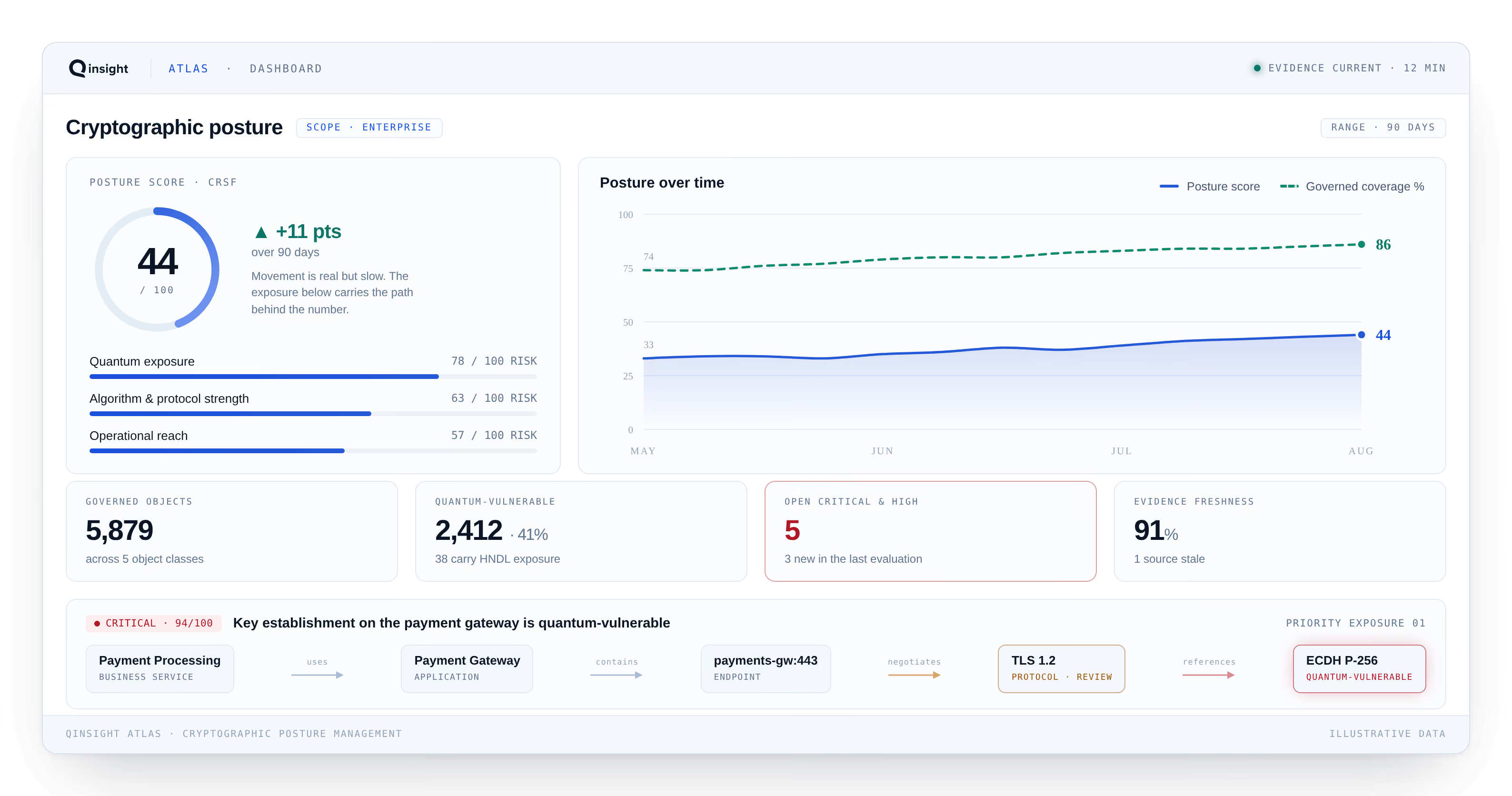
Qinsight Atlas is a cryptographic posture management platform for enterprise discovery, inventory and post-quantum readiness. Connect cryptographic assets to the systems, owners and dependencies that determine what to protect and prioritize.

.avif)

Every digital interaction has cryptography underneath it. Most organizations still manage that foundation as fragments.
Certificates sit in one tool. Libraries sit in code. Protocol behavior is observed somewhere else. Ownership lives in a CMDB, or in someone's head. A spreadsheet can list objects; it cannot explain the estate.
The NIST IR 8547 draft proposes deprecating 112-bit classical security, including RSA-2048, after 2030, and disallowing it after 2035.
When confidentiality must hold longer than the cryptography protecting it, harvest-now-decrypt-later becomes a present-tense problem.
Discovery, pilots, dependency mapping and staged rollout. The schedule is set by your estate, not by a prediction.
From hidden signals to migration-ready context
Each stage produces evidence the next stage can trust.
Collect
Network observations, infrastructure APIs, code analysis, files, KMS metadata and imported CBOMs.
Normalize
Canonical objects without losing provenance. One key seen three times is one key.
Correlate
Relationships, ownership and dependencies. What breaks when this changes?
Assess
Findings with context, evidence and stated uncertainty.
Report
Operational and executive evidence, exportable and defensible.
A posture you can explain, not just display
Every useful answer should be traceable to a source, an observation, a relationship and a point in time. That is what separates an enterprise system of record from a dashboard.
Honest about gaps
Expose missing context and incomplete coverage instead of turning uncertainty into false certainty. An inventory that hides what it could not see is an inventory nobody can sign off on.
Provenance stays attached
Keep the collection method, scope and evidence on every observation. A record without provenance cannot be defended.
Objects become decisions
Relate technical objects to deployed systems, owners and business services. An algorithm alone is not a decision.
History is half the record
Preserve first seen, last observed, drift and conflict history. Current state alone tells you nothing about direction.
Give every stakeholder the view their decision requires
One record can answer technical, operational, risk and executive questions without creating four competing inventories.
Discover, inventory and assess cryptography
Cryptographic discovery
See across every surface, network, cloud, code, files, keys and imported evidence.
Inventory & CBOM
Create a living system of record with relationships, owners and observation history.
Risk assessment
Make prioritization explainable before it becomes a score.
Quantum readiness
Understand the regulatory schedule and build an evidence baseline against it.
Regulated estates, different constraints
The cryptography is similar everywhere. What differs is data lifetime, change tolerance and who is asking for evidence.
Financial services
Payments, identity, markets and core systems, with dependencies that cross counterparty boundaries.
Government & defense
Federal acquisition and national-security requirements are making cryptographic readiness a near-term procurement issue for agencies and suppliers.
Healthcare & life sciences
Data with retention horizons measured in decades, inside validated systems that resist change by design.
Critical infrastructure
Assets built to run for thirty years, where availability outranks confidentiality and active scanning is often prohibited.
Cryptographic posture management, explained
Clear answers to the questions security, infrastructure and risk leaders ask before they trust a cryptographic discovery program.

Know what protects your business. Prepare it for what comes next.
Prove it in one environment. Leave with a record an auditor can check.