
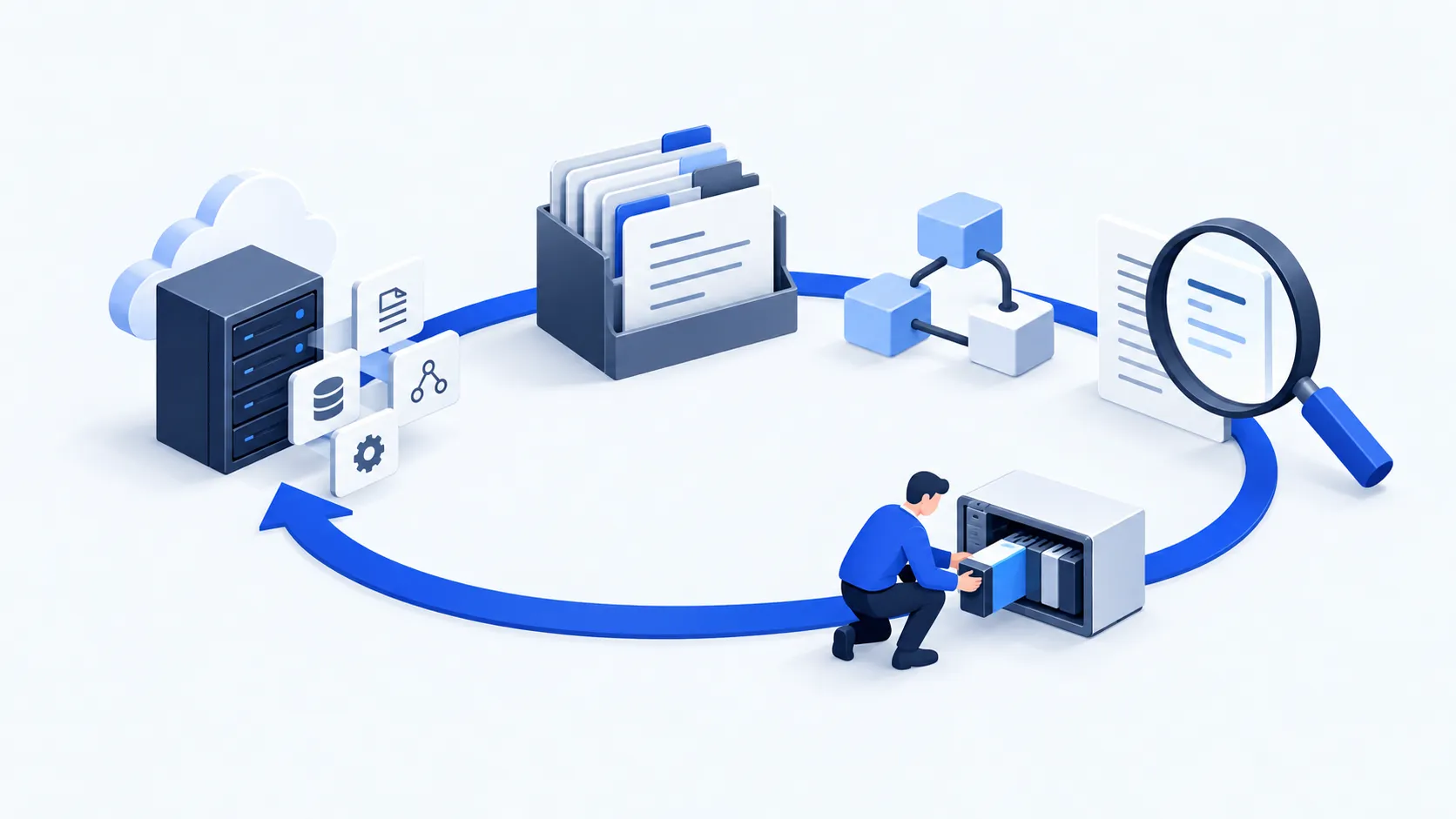
Cryptographic Posture Management (CPM) is the operating discipline for managing cryptographic risk across a changing enterprise. It brings evidence from different sources into a consistent inventory, adds technical and business context, evaluates the resulting posture, and supports accountable action. Repeating that process keeps decisions connected to the environment as it changes.
A certificate appears in a network scan, a cloud service reports a managed key, and a software inventory identifies a cryptographic library. Each observation is useful. The enterprise still needs to establish which systems use those objects, whether they meet policy, who should act, and how to confirm that a change worked.
At Qinsight, we organize this lifecycle into five stages: collection, normalization, enrichment, assessment and action. Verification closes the loop by bringing fresh evidence back through the same stages.
The stages describe an ongoing process. Different services can be at different points in the cycle, and new evidence can change an earlier conclusion.
The framework at a glance
- Collection: Gather scoped observations and retain their source, method and age.
- Normalization: Reconcile records while preserving distinct objects, uses and conflicting evidence.
- Enrichment: Connect technical evidence to ownership, business context and known relationships.
- Assessment: Evaluate requirements, identify evidence gaps and determine remediation priorities.
- Action: Assign accountable work and define how the outcome will be verified.
Verification closes the loop: collect fresh evidence after a change and reassess the affected scope.
1. Collection establishes the evidence
Cryptography spans network protocols, certificates, keys, libraries, application configurations, cloud services, databases and third-party products. Collection brings together evidence from the sources available within an agreed scope. That can include active discovery, read-only integrations, code analysis, and imported artifacts such as a Cryptographic Bill of Materials (CBOM). Each method sees a different part of the environment.
The method matters to the conclusion. A configuration record may describe what a service permits. A code finding may identify a cryptographic dependency without establishing that it is used in a deployed application. A completed test connection can show what that particular exchange negotiated, under the conditions of the test. It does not establish what every production client uses.
Useful observations therefore retain their source, collection time, scope and method. Failed access, unsupported systems and unexamined environments also need to remain visible. An inventory can appear reassuring simply because the difficult systems were never examined.
Collection should repeat at a cadence appropriate to the environment and after relevant changes. A regularly updated operating process does not require every source to be monitored continuously. It requires teams to know how current their evidence is and where it stops.
2. Normalization makes the evidence comparable
Different sources describe the same environment in different ways. Algorithm names vary, identifiers serve different purposes, and several tools may report the same certificate or endpoint. Without normalization, combining sources can increase the volume of records while leaving the underlying questions unresolved.
Normalization maps source records into a common data model: consistent object types, attributes and relationships that can be compared across tools. It also reconciles duplicate observations without erasing meaningful differences.
Consider one certificate observed on five endpoints. A useful inventory represents the certificate once while preserving all five uses. Counting five unrelated certificates exaggerates the number of distinct objects. Collapsing the observations into a single deployment conceals the scope of a future replacement. Object identity and object usage both matter.

The same care applies to conflicting observations. Two reports may differ because they cover different environments, were collected at different times, or describe configuration and negotiated behavior respectively. Their provenance should survive normalization so an analyst can resolve the difference. A clean-looking record is not necessarily a more accurate record.
Normalization also makes portable evidence more useful. CycloneDX CBOMs can represent cryptographic assets and relationships to software components. Imported or exported, that evidence still needs an understood scope and collection context before it supports a conclusion about the current environment.
3. Enrichment connects cryptography to its context
Once observations can be compared, enrichment connects them to information from other sources. An endpoint observed by a network scan may also appear in an asset platform. A configuration management database (CMDB) may associate that asset with an application or responsible team. Together, those records can make a cryptographic finding easier to investigate and assign.
Enrichment can add technical relationships, environment details, ownership, business criticality and information about the service or data being protected. Some context comes from integrations; some requires confirmation by application owners. Matching a record does not guarantee that every attribute is current or that every business relationship is known.
Relationships deserve the same scrutiny as objects, including their freshness. A connection reported directly by a source and a relationship inferred by correlating records have different evidential foundations. Analysts should be able to understand the basis of a relationship, particularly when it will influence change planning.
A graph view makes these connections easier to explore: start with a cryptographic object, examine the endpoints and applications connected to it, and follow the available dependencies. Missing ownership, stale CMDB records and unconfirmed associations remain work to resolve. Making those gaps visible improves the usefulness of the inventory.
4. Assessment turns context into decisions
Assessment evaluates the normalized, enriched evidence against applicable requirements. These may concern approved algorithms, protocol settings, certificate validity, key properties or readiness for a planned cryptographic transition. A defensible finding explains the condition observed, the requirement being applied, the affected scope and the evidence behind the result.
The process needs an explicit way to handle insufficient evidence. A missing observation cannot establish that a system meets policy. Where the evidence cannot answer the question, the next action may be further collection or owner validation.
Dependency analysis gives findings operational meaning. Relationships established during normalization and enrichment help teams examine which applications share a cryptographic dependency, where a change may have downstream effects, and which owners need to coordinate. The graph supports investigation; the completeness of the answer depends on the relationships actually captured.
A policy result records whether the available evidence demonstrates that a requirement is met within the assessed scope. A remediation priority determines when and how the organization should respond. Prioritization considers the technical condition alongside exposure, business criticality, data sensitivity, required confidentiality lifetime, vendor constraints and change complexity. A shared component used by several critical applications may need coordinated remediation. Two instances of the same algorithm may require different schedules because their uses and constraints differ.
This context is particularly important for post-quantum cryptography (PQC). The NIST NCCoE migration project connects cryptographic discovery with risk management and prioritization. An enterprise needs to understand where quantum-vulnerable mechanisms are used and what depends on them before it can plan a credible transition.
Assessment should also repeat when requirements change. An updated policy or a revised migration deadline can alter the judgment of an unchanged environment. Keeping observations traceable lets teams revisit that judgment without confusing a new requirement with a newly discovered technical condition.
5. Action makes the decision accountable
Assessment produces value when someone can act on its conclusions. Depending on the finding, action may mean a configuration change, certificate replacement, library upgrade, vendor escalation, additional investigation, or a documented exception with an owner and review date.
For remediation, the finding should become a usable work item in the organization’s existing process. Whether created manually or through a supported ticketing integration, it should carry enough context for the responsible team to proceed:
This is where remediation workflows and ticket creation belong in the lifecycle. Their purpose is to preserve the connection between a technical finding and the work done to address it. Creating a ticket alone does not change cryptography. Application teams, infrastructure teams, vendors, and operational systems such as public key infrastructure (PKI) and key-management platforms carry out changes under the organization’s controls.
Shared dependencies can also change how work is organized. The five endpoints using one certificate may need a coordinated replacement plan. Treating each observation as an unrelated ticket can obscure that coordination and duplicate effort.
Verification brings the result back into the cycle
A closed work item records a workflow outcome. Verification establishes whether the intended technical outcome occurred. After a change, teams collect fresh evidence, normalize and enrich it, then reassess the affected scope against the acceptance criteria.
For the certificate example, confirmation should cover the intended endpoints. For a protocol change, the evidence should address the required behavior. If the objective is to use an approved key-establishment mechanism, a product’s support statement or the appearance of an algorithm name in a configuration is insufficient. The relevant exchange must be checked under the conditions the organization needs to validate.
This feedback can reveal a partial rollout, a missed dependency or a continuing exception. It also gives the team a basis for closure: a record of what changed, where it was checked and what remains unresolved. Later observations can then show whether the intended state persists.
Measure the quality of the cycle
A larger inventory can reflect better collection rather than worsening posture. A falling finding count can reflect less collection rather than successful remediation. Measures are more useful when they include scope and evidence quality:
These measures help teams distinguish improved visibility from actual risk reduction and identify which stage of the process needs attention.
How Qinsight approaches the lifecycle
Qinsight is building Atlas around this operating model. The foundation combines cryptographic collection, normalization and a graph-based inventory so observations can be examined alongside relationships between endpoints, applications and cryptographic objects. Our approach to enrichment connects technical evidence with additional context, including CMDB information where available.
We are extending this foundation with configurable policy evaluation and workflow handoff. The goal is for teams to carry the evidence behind a finding through investigation, prioritization and action, then use fresh observations to assess the result.
Related reading
- CBOM and cryptographic inventory: the two essential layers of cryptographic visibility — understand how portable component records relate to deployed environments.
- Post-quantum migration: a practical five-stage framework — apply cryptographic visibility and prioritization within a broader migration program.
Sources
- OWASP CycloneDX: Cryptography Bill of Materials (CBOM) — representation of cryptographic assets and their relationships to software components.
- NIST NCCoE: Migration to Post-Quantum Cryptography — cryptographic discovery, risk management, prioritization and interoperability.
Our guide to cryptographic posture management use cases organizes immediate operational needs around five security outcomes: availability, incident response, exposure reduction, trust and machine identity, and assurance. It also explains how dependency context supports PQC migration.
Next step: Begin with one important service. Agree what evidence is needed, connect the available context, identify an owner for each decision, and define how the outcome will be checked. Work with Qinsight to scope that first cycle.
Build the evidence behind the argument.
Start with one accredited boundary or one delivered system and produce evidence a reviewer will accept.