
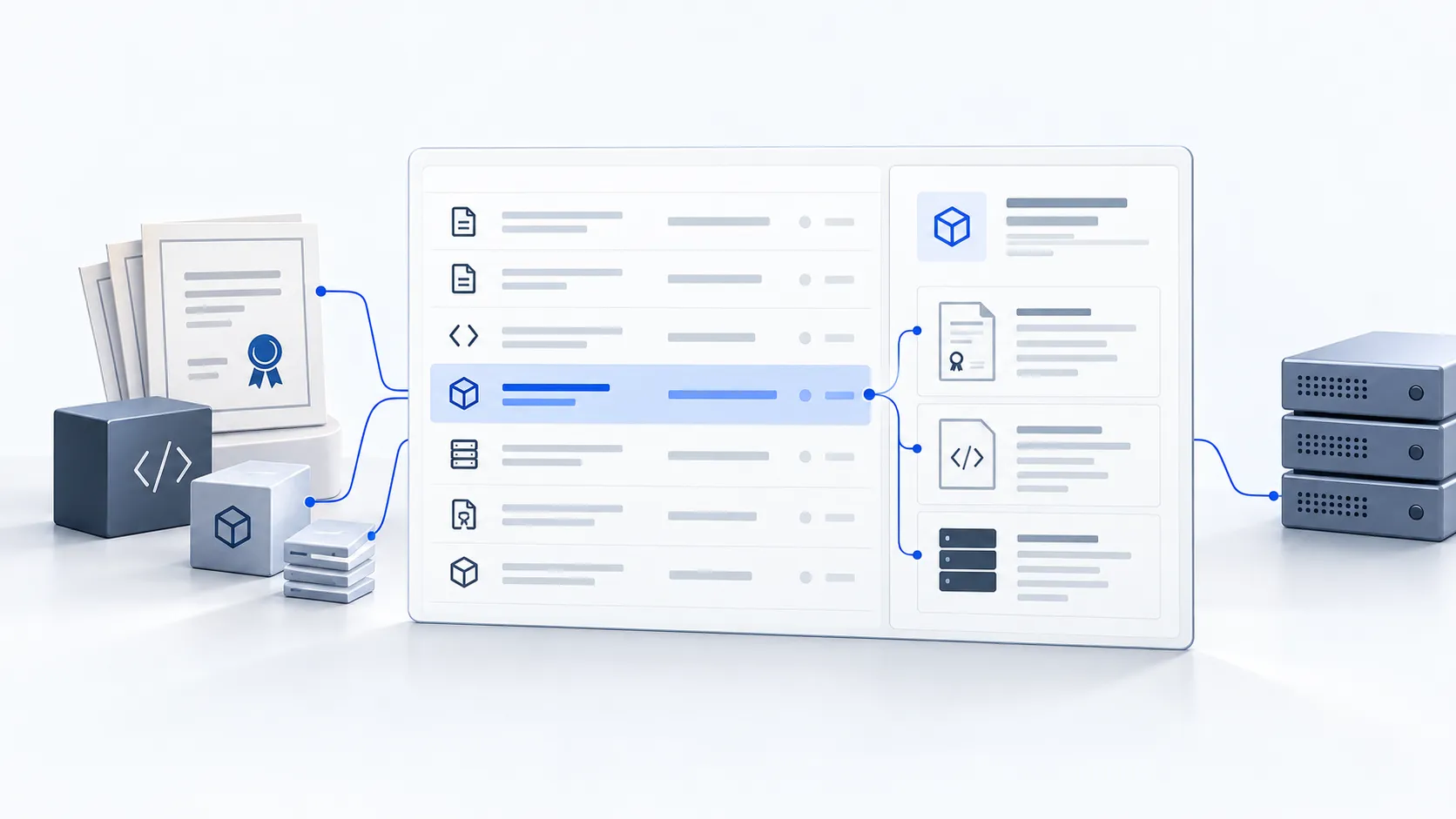
Cryptographic posture management (CPM) connects discovery and inventory with risk assessment, ownership and remediation planning. Its purpose is to help teams make defensible decisions about cryptography as their environment changes, and retain the evidence needed to check the results.
Enterprises manage cryptography through the systems that issue certificates, store keys, scan networks and enforce encryption. Each has an important role, but each sees only part of the environment. Security teams need to connect those views to understand which business services are exposed and what they can safely change.
Post-quantum cryptography (PQC) migration makes that work more urgent. Organizations need to identify quantum-vulnerable public-key cryptography and plan changes across the applications, infrastructure and suppliers that depend on it. [1] Separately, shorter lifetimes for publicly trusted TLS certificates increase the importance of reliable renewal and deployment processes. [2] Cloud services and third-party software add dependencies that cross organizational boundaries.
Inventory establishes the foundation
A cryptographic inventory records information about keys, certificates, algorithms, libraries, protocols and configurations. To support decisions, it also needs to connect those records to their use, location and supporting evidence. NIST identifies cryptographic discovery and inventory as a starting point for PQC migration. [1]
Consider two services using RSA-2048 for authentication. One is a disposable test service with no sensitive data or production trust relationships. The other is a customer-facing production service on which several business processes depend. Both use quantum-vulnerable public-key cryptography, but their consequences, dependencies and migration priorities differ.
The cryptographic function matters too. A key used for authentication raises different questions from one used to establish a shared secret or sign software updates. An algorithm name alone cannot establish the risk to confidentiality, identity or software integrity.
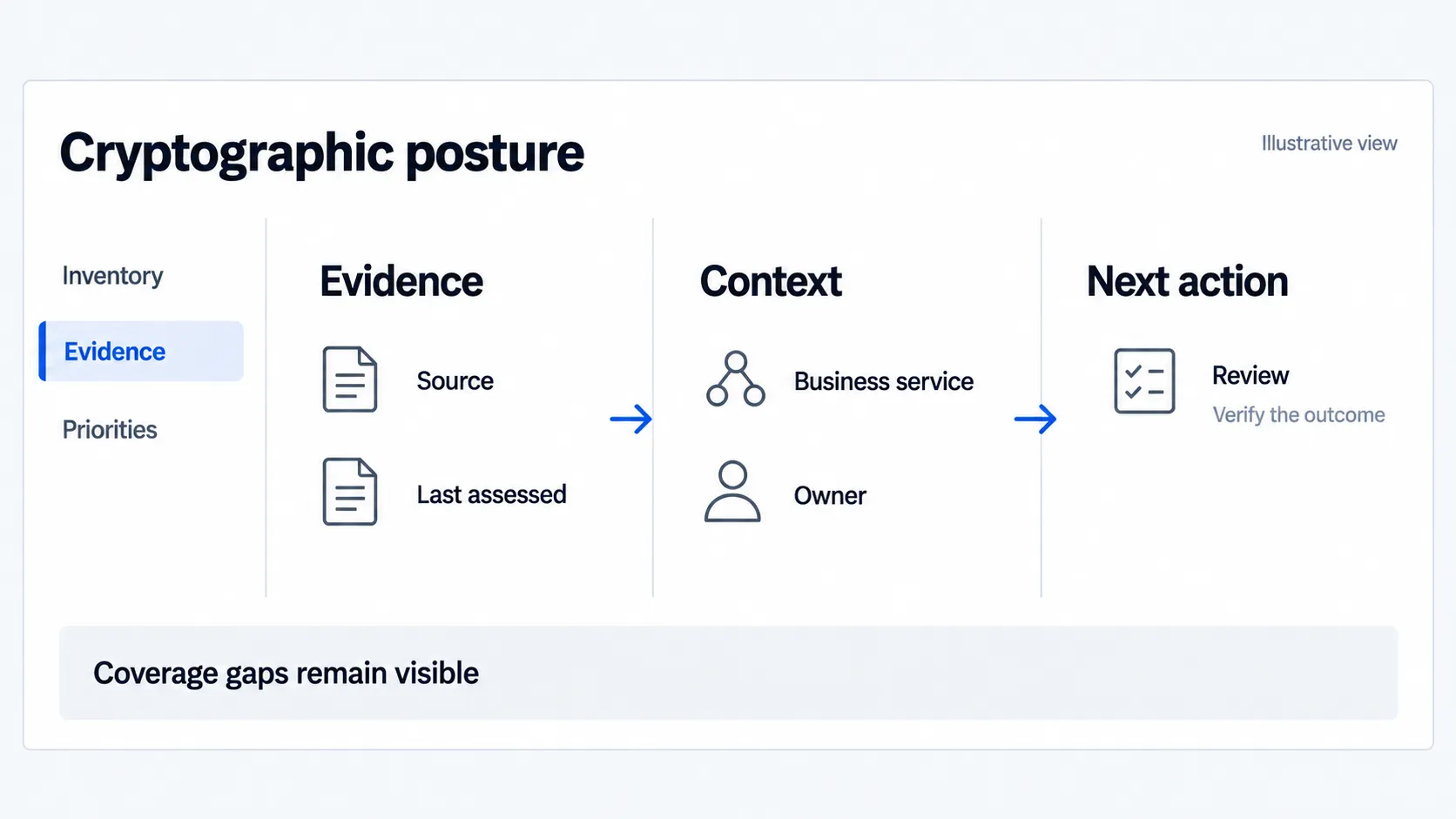
CPM should help teams establish what the cryptography protects, who owns the affected service, which policies apply and what would be involved in changing it. Where those answers are missing, the inventory should make the gaps visible.
For a closer look at component records and deployed environments, see our guide to CBOMs and cryptographic inventories.
Posture depends on the quality of the evidence
A finding is useful only when a team can understand how it was established. Relevant details include the collection method, observation time, assessed environment and any limitations.
A vendor statement that a product supports an algorithm, a configuration that enables it and evidence that a particular connection negotiated it support different conclusions. Keeping those distinctions visible helps prevent a capability claim from becoming an unsupported assertion about protection in production.
Coverage matters just as much. A scan of one network segment does not establish the posture of an entire enterprise. Unreachable systems, missing integrations and incomplete classification should remain recorded gaps. Otherwise, a clean-looking report may conceal the areas that need attention.
Keep the inventory current enough to guide decisions
Periodic assessments provide useful baselines and independent reviews. Between them, however, certificates rotate, cloud workloads change and applications acquire new dependencies. The evidence used to plan a change can become stale before the change is made.
A CPM program therefore needs repeatable discovery at a cadence appropriate to the environment. That may combine scheduled scans, API-based collection and updates triggered by changes where supported. Teams should be able to see when evidence was last refreshed and which parts of the environment have been reassessed.
During a multi-year PQC migration, this allows teams to revisit priorities as services and vendor capabilities change. The useful questions are what changed, whether the change affects risk, and who needs to respond.
Prioritize the risk and the work needed to reduce it
A flat list of thousands of RSA and elliptic-curve assets gives a CISO little basis for choosing a starting point. Prioritization should connect technical findings to data sensitivity and confidentiality lifetime, exposure, business criticality and applicable obligations.
Migration sequencing also depends on the ability to act. A critical service may require a supplier release, a hardware replacement or coordinated testing with a business partner. Another finding may be resolved through a supported configuration change. Teams need to understand both the consequences of leaving an exposure in place and the time needed to address it.
A clear rationale is more useful than an unexplained score. It should show which factors drove the priority, what assumptions were made and which missing information could change the decision.
Dependencies shape the scope of a change
Cryptographic assets rarely operate alone. Several applications may depend on one library, certificate authority or key-management service. Changing an endpoint can also affect clients and counterparties that use it.
Dependency mapping helps teams connect findings to identified consumers and supporting components. Its value depends on the relationships the available evidence can establish. An unknown dependency should remain unknown, and a map should guide validation rather than imply that every consequence has been predicted.
Before a change, the service owner still needs to confirm compatibility, coordinate affected teams and define acceptance criteria. This supports crypto-agility: the ability to adapt cryptography while preserving security and operations. [3]
Connect remediation to verification
Posture management becomes operational when a finding has an owner, an agreed response and a way to check the outcome. The response may be an upgrade, a configuration change, further investigation or a documented exception with a review date.
Closing a ticket does not establish that the intended protection is in place. For a transport change, verification may require evidence from the relevant connection and client. For a signing change, it may require testing the signer, verifier and trust policy together.
Progress reporting should therefore show validated changes alongside unresolved findings and assessment coverage. A lower finding count may reflect successful remediation, but it could also result from reduced coverage. Teams need enough context to distinguish those outcomes.
The CISO test for cryptographic posture management
The practical test is whether the resulting information supports decisions. Leadership should be able to ask:
These questions apply to PQC migration, certificate operations, weak configurations and other cryptographic changes. CPM provides a repeatable way to connect the technical evidence with the people and processes responsible for acting on it.
How Qinsight approaches this
At Qinsight, we are building Atlas around this progression: discover cryptography, organize the evidence, connect it to context and dependencies, and help teams decide what to address next. The coverage and conclusions available depend on the discovery methods, integrations and scope used.
For us, useful cryptographic posture management means a team can trace a finding to its evidence, understand what is still missing and make an informed decision about the next change.
Related reading
- Post-quantum migration: a practical five-stage framework — turn visibility and prioritization into a migration program.
- Why PQC migration is still an enterprise responsibility — understand the work that remains with the organization as vendors deliver new capabilities.
Sources
- NIST NCCoE: Frequently Asked Questions about Post-Quantum Cryptography
- CA/Browser Forum: Ballot SC081v3 on reducing certificate validity and validation data reuse periods (April 11, 2025).
- NIST: Considerations for Achieving Crypto Agility: Strategies and Practices — CSWP 39upd1, updated June 29, 2026.
About Qinsight: Qinsight is building Atlas to help teams discover cryptography, organize evidence and assess cryptographic risk.
Next step: Choose one business service, define the discovery scope and record the evidence and ownership gaps. Plan a scoped discovery pilot with Qinsight.
Build the evidence behind the argument.
Start with one accredited boundary or one delivered system and produce evidence a reviewer will accept.