

The hardest part of post-quantum cryptography (PQC) migration is not learning the names of the new algorithms. It is determining where quantum-vulnerable cryptography is actually used, what depends on it, and how to change it without disrupting the business.
NIST finalized its first three principal PQC standards—ML-KEM for key establishment and ML-DSA and SLH-DSA for digital signatures—in 2024 and has encouraged organizations to begin migrating. That removed a major source of uncertainty. It did not make the enterprise transition simple. RSA, finite-field Diffie-Hellman, and elliptic-curve cryptography remain embedded across certificates, protocols, applications, software libraries, hardware security modules, identity systems, and vendor products. Replacing them can affect trust chains, interoperability, performance, key lifecycles, and audit evidence.
Strictly speaking, this is primarily a public-key migration. Quantum computing also changes the security margins of symmetric algorithms and hash functions, but it does not affect them in the same way. A credible program therefore begins by identifying the cryptographic functions that are vulnerable, rather than treating every algorithm as equally exposed.
Organizations usually face three practical questions:
- How prepared are we today?
- What should we address first?
- How will we know that the migration worked?
The five-stage framework below provides a practical way to answer them. It is informed by the sequence reflected in joint CISA, NSA, and NIST guidance—establish a roadmap, engage vendors, build an inventory, and prioritize sensitive and critical assets—and by NIST's work on cryptographic discovery, interoperability, and crypto-agility.
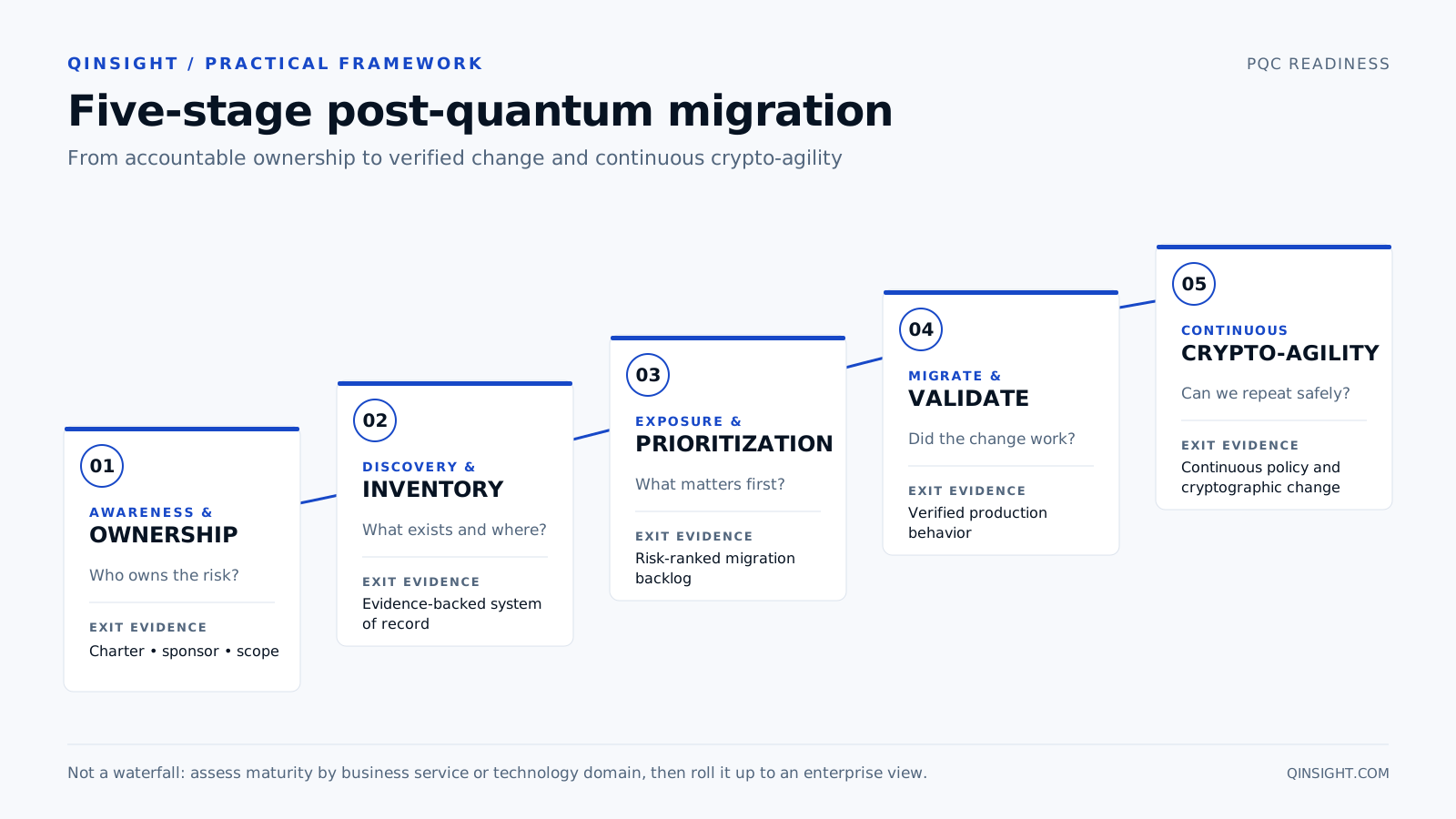
The framework at a glance
- Awareness and ownership: Who owns the risk, scope, and program?
- Discovery and inventory: What cryptography exists, where is it, and how is it used?
- Prioritization: Which exposures matter first, and why?
- Migration and validation: Was the change deployed safely, and is the intended cryptography actually in use?
- Crypto-agility: Can the organization repeat the process quickly and safely as requirements change?
This is not a waterfall model. A financial institution may be validating PQC on an internet-facing service while still discovering embedded cryptography in a mainframe application or vendor-managed payment platform. Maturity should be assessed by business service and technology domain, then rolled up to an enterprise view.
Stage 1: Awareness and accountable ownership
At Stage 1, leadership understands that quantum computing creates a future risk, but the organization has not yet converted that concern into an operating program. Teams may be monitoring standards, attending industry events, or answering board questions, yet no one can state with confidence where vulnerable public-key cryptography is used or who owns the migration.
This stage is often described as an awareness gap. In practice, the more important gap is accountability. PQC touches security architecture, PKI, identity, infrastructure, application development, data governance, procurement, legal, risk, and business operations. If the work belongs to everyone in principle but no one in practice, it stalls.
The immediate objective is not to select an algorithm. It is to establish the conditions for discovery:
- Name an executive sponsor and an accountable program lead.
- Define the initial scope, beginning with critical services and long-lived sensitive data.
- Agree on a common vocabulary for assets, cryptographic components, usage, ownership, and evidence.
- Identify the internal systems, teams, tools, and external providers needed to build the inventory.
- Begin asking strategic vendors for product-specific PQC roadmaps, supported standards, dependencies, and upgrade constraints.
For financial institutions, the first scope should typically include payment systems, customer identity, external communications, PKI and HSM infrastructure, key-management services, transaction platforms, long-term archives, and third-party services that support critical operations.
Primary challenge: Converting diffuse concern into accountable action without prematurely narrowing the problem to a single product or algorithm.
Stage 1 outcome: A funded charter, accountable owner, initial scope, cross-functional working group, and documented discovery plan.
Stage 2: Cryptographic discovery and inventory
Stage 2 answers the foundational question: Where does cryptography exist, and how is it being used?
The NIST National Cybersecurity Center of Excellence migration project places cryptographic discovery at the center of migration because organizations cannot prioritize or replace what they cannot identify. In a modern enterprise, that requires more than scanning certificates. Cryptography appears in network protocols, source code, application configurations, APIs, containers, cloud services, databases, PKI, KMS and HSM platforms, secrets-management systems, code-signing pipelines, mobile applications, operational technology, and commercial software.
A useful inventory should record enough context to support a decision. At minimum, that means the algorithm or protocol, parameters such as key size or mode, cryptographic function, location, environment, owner, observed usage, protected data or business service, dependencies, discovery source, evidence, and confidence level.
It is also important to distinguish three different views:
- Declared state: what documentation, policy, or a software manifest says should exist.
- Configured state: what a system is capable of using or has been configured to allow.
- Observed state: what the system actually negotiates or uses in operation.
A Cryptographic Bill of Materials (CBOM) can provide component-level structure and traceability, while operational discovery shows where those components are deployed and how they behave. Neither should be treated as permanently accurate. The objective is a living cryptographic system of record with measurable coverage and freshness—not a one-time spreadsheet that begins aging as soon as it is completed.
Primary challenge: Achieving defensible coverage across heterogeneous environments while making unknowns, stale evidence, and blind spots visible.
Stage 2 outcome: An evidence-backed cryptographic inventory that links vulnerable public-key mechanisms to assets, owners, business services, data, dependencies, and actual usage.
Explore cryptographic discovery methods and coverage across enterprise environments.
Stage 3: Exposure, dependencies, and prioritization
Discovery creates a body of facts. Stage 3 turns those facts into a sequence of decisions.
Not every RSA key, ECC certificate, or vulnerable protocol creates the same urgency. The significance of a cryptographic exposure depends on what it protects, how long that information must remain confidential or trustworthy, where the system is exposed, what business process depends on it, and how difficult it will be to change.
A defensible prioritization model should consider at least six dimensions:
- Cryptographic vulnerability: algorithm, protocol, key size, mode, implementation, and usage.
- Data lifetime: how long the protected information must remain confidential, including exposure to harvest-now-decrypt-later collection.
- Business and mission impact: the consequences of confidentiality, integrity, authentication, or availability failure.
- Exposure and actual behavior: whether the system is internet-facing, internally reachable, isolated, or negotiating a vulnerable fallback path in production.
- Dependency and blast radius: the applications, identities, trust chains, counterparties, and business services that rely on the component.
- Migration constraint: whether the change is controlled internally or depends on a vendor, protocol profile, HSM, embedded device, mainframe, hardware refresh, or coordinated ecosystem change.
This is familiar enterprise-risk logic applied to a technical domain. The goal is not to assign a dramatic score to every object. It is to make the basis for priority explainable and repeatable. Unknown ownership, low-confidence observations, and missing vendor roadmaps should be surfaced as risks rather than silently omitted from the queue.
Financial institutions must pay particular attention to long-lived customer and transaction data, payment and settlement systems, signing and identity infrastructure, interbank communications, and shared platforms in which migration depends on counterparties. The Bank for International Settlements' roadmap for quantum readiness in the financial system similarly emphasizes awareness, inventory, coordinated planning, execution, crypto-agility, and defense in depth.
Primary challenge: Connecting technical exposure to business impact and migration constraints without allowing the size of the inventory to obscure the assets that matter most.
Stage 3 outcome: A risk-ranked migration backlog mapped to business services, accountable owners, dependencies, vendor roadmaps, and documented rationale.
See Qinsight’s approach to cryptographic risk assessment and how evidence informs prioritization.
Stage 4: Governed migration and production validation
Stage 4 is where inventory becomes change. The organization now has enough evidence to select migration patterns, sequence work, test interoperability, and validate outcomes.
The first decision is architectural, not merely algorithmic. ML-KEM addresses key establishment; ML-DSA and SLH-DSA address digital signatures. They are not interchangeable, and the correct choice depends on the protocol, trust model, performance envelope, standards profile, and product ecosystem. Some systems can be changed through configuration. Others require a library or runtime upgrade, a new certificate profile, a protocol change, a vendor release, a hardware refresh, or an application redesign. Systems that are no longer needed should be retired rather than migrated.
A mature Stage 4 program should:
- Define approved migration patterns and cryptographic policies for each use case.
- Pilot representative systems before scaling, including both internally controlled and vendor-dependent paths.
- Use hybrid mechanisms where they are appropriate and supported as transition tools—not as proof that migration is complete.
- Test certificate chains, key-management workflows, HSM and KMS behavior, backup and recovery, rollback, failover, and interoperability with counterparties.
- Measure the operational impact of larger keys, signatures, certificates, and handshake messages under realistic load.
- Verify the cryptography actually negotiated or used in production, including downgrade and fallback behavior.
- Preserve evidence for risk, audit, architecture, and change-management teams.
Coordination remains the central operating challenge. Security cannot complete this migration alone. Application owners, platform teams, enterprise architecture, infrastructure, identity, procurement, vendor management, risk, legal, and business leaders need a shared view of priorities, decisions, exceptions, and residual risk.
Migration progress should therefore be measured by verified outcomes, not by whether a new algorithm appears in a product data sheet. A system that supports ML-KEM but continues to negotiate a vulnerable key exchange in production is not yet migrated. The four-state model for vendor capability and enterprise verification makes those distinctions explicit.
Primary challenge: Changing cryptographic dependencies across interconnected systems without introducing outages, silent fallback, or unverified claims of readiness.
Stage 4 outcome: Priority services are migrated through governed change, their production behavior is validated, and residual risks and exceptions are explicitly owned.
Stage 5: Continuous crypto-agility
PQC migration is a major milestone, but it is not the durable end state. The end state is crypto-agility: the organizational and technical capability to replace or adapt cryptography while preserving security and ongoing operations.
NIST's current crypto-agility guidance treats this as a capability spanning protocols, applications, software, hardware, firmware, and infrastructure. That breadth matters. A wrapper around one cryptographic library may improve a single application, but enterprise crypto-agility also requires governance, inventory, testing, vendor coordination, policy enforcement, and operational feedback.
At Stage 5, the capabilities developed for PQC become continuous controls:
- Discovery runs repeatedly and detects cryptographic drift.
- Approved algorithms, parameters, and exceptions are expressed as enforceable policy.
- Applications use well-governed cryptographic services, interfaces, and abstraction layers instead of hard-coded choices where practical.
- CBOMs and operational inventories stay linked to deployed systems and business ownership.
- Procurement and contracts require usable cryptographic inventories, migration support, and change timelines from vendors.
- Repeatable interoperability, performance, rollback, and conformance tests are part of the delivery lifecycle.
- Incident-response playbooks support rapid action when an algorithm, certificate authority, library, or implementation becomes unsafe.
PQC will not be the last cryptographic transition. Standards will evolve, implementations will fail, certificate lifecycles will continue to shorten, and new vulnerabilities will emerge. Organizations that treat PQC as a one-time replacement project may reproduce the same discovery and coordination problem later. Organizations that institutionalize crypto-agility create a repeatable way to manage change.
Read more about crypto-agility and the gap between risk and response.
Primary challenge: Turning a time-bound migration program into a durable operating capability across technology, people, process, and third-party relationships.
Stage 5 outcome: Cryptographic change can be identified, prioritized, tested, deployed, and verified continuously—with materially less disruption and uncertainty.
Measuring progress without creating false confidence
Counting how many products support a PQC algorithm is not enough. Better measures connect coverage, ownership, risk, and observed behavior:
- Discovery coverage: Percentage of critical services examined across agreed discovery surfaces.
- Inventory confidence: Percentage of cryptographic records supported by current evidence, ownership, and dependency context.
- Prioritization coverage: Percentage of critical services with a documented quantum-risk rating and migration disposition.
- Vendor readiness: Percentage of critical third-party products with a dated, product-specific PQC roadmap and named owner.
- Validated migration: Percentage of priority flows observed using approved cryptography without vulnerable fallback.
- Exception exposure: Number and business impact of overdue, unowned, or unsupported exceptions.
- Change velocity: Time required to identify affected systems, approve a response, deploy the change, and verify the result.
These metrics do not require perfect knowledge before work begins. They make uncertainty visible and allow the program to improve its evidence over time.
The bottom line
Post-quantum migration is not a race to install a new algorithm. It is an enterprise change program for replacing cryptographic dependencies safely across a complex and interconnected estate.
The organizations best positioned for the transition will begin with accountable ownership, build an evidence-backed inventory, prioritize using business context, validate actual behavior after migration, and preserve those capabilities as part of an ongoing crypto-agility program. That is how quantum readiness moves from a broad concern to a measurable operating capability.

Start with one critical business service. Define the discovery scope, identify its cryptographic dependencies, and agree the evidence needed to prioritize migration. Plan a discovery pilot with Qinsight.
Build the evidence behind the argument.
Start with one accredited boundary or one delivered system and produce evidence a reviewer will accept.