Cryptographic Risk Assessment

// Cryptographic Risk Analysis //

Analyze Post-Quantum Risks and Protect  Your Most Vulnerable Assets

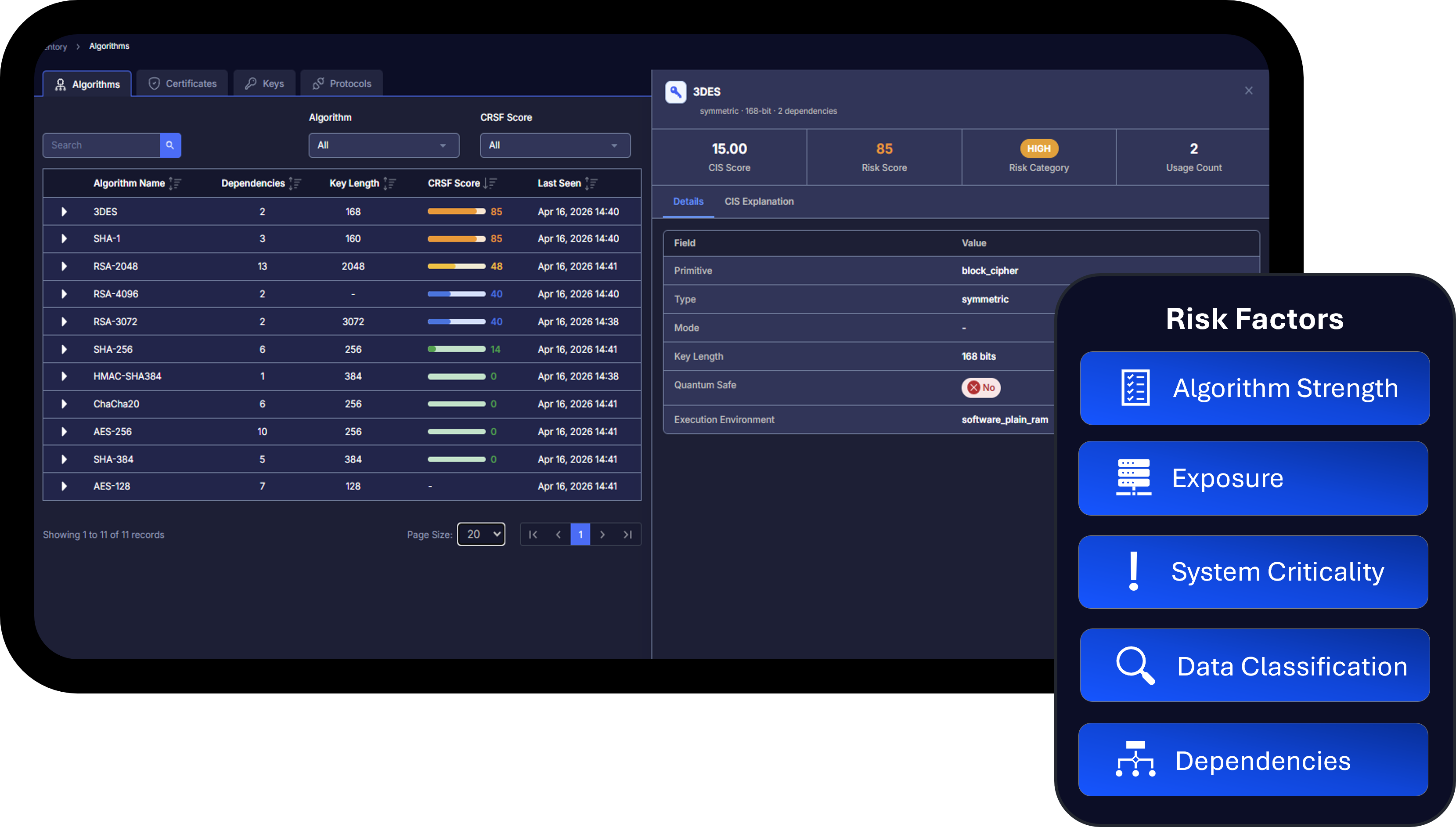
Analyze your cryptographic estate to ensure that algorithms, protocols, ciphers, certificates and key lengths are secure against cryptographically relevant quantum computers. Protect your most vulnerable assets with guided remediation workflows to migrate to NIST approved quantum-secure encryption.

Identify Quantum Risks

Keys & Keystores

Centralized record of all encryption keys and secure storage locations.

Certificates

Comprehensive inventory of digital certificates with issuer, algorithm and expiration details

Protocols

Catalog of cryptographic communication standards like TLS, SSH, and IPsec configurations.

Algorithms

List of encryption and hashing algorithms in use with associated security levels.

Libraries

Inventory of cryptographic software components and dependencies across applications and services.

Cipher Suites

Detailed mapping of protocol cipher combinations and their encryption strength or vulnerabilities.

// Stakeholders //

Who Needs a Cryptographic Inventory & Posture Management Platform?

Protection Icon - Cybersecurity X Webflow Template

CISOs and Security Architects

Get instant visibility into where encryption lives, what is implemented, and posture scoring so you can prioritize weak or misconfigured cryptography, conduct audits or create a roadmap and plan for PQC migration.

Monitoring Icon - Cybersecurity X Webflow Template

PKI & Crypto Governance Teams

Maintain a living inventory of algorithms and certificates, key/cert lifecycles, ciphers and protocols relevant to each data source. APIs provide flexibility and guided remediation instructions improve internal crypto-agility capabilities.

Monitoring Icon - Cybersecurity X Webflow Template

Compliance, risk and InfraSec leaders

Produce audit-ready reports and dashboards mapped to NIST / NSA PQC guidance, with continuous monitoring and audit logs that embed smoothly into existing compliance workflows.

Empowering Users Image - Cybersecurity X Webflow Template
// Key Benefits  //

Benefits of a Cryptographic Inventory

Enhanced Security

Identify and remediate weak or misconfigured cryptography before attackers exploit vulnerabilities.

Operational Efficiency

Centralize cryptographic management to streamline audits, updates and remediation workflows.

Stay Ahead With Our Cybersecurity - Cybersecurity X Webflow Template

Regulatory Compliance

Maintain visibility and evidence to meet evolving data protection and PQC regulations such as CNSA 2.0.

Reduced Attack Surface

Eliminate unused, expired, or weak cryptographic assets that increase organizational exposure.

Industry Standards & Best Practices

Align encryption practices with NIST, NSA and sector-specific cryptographic security frameworks.

Quantum Readiness

Assess and plan migration from vulnerable algorithms to NIST-approved post-quantum standards.

// FAQ//

Frequently Asked Questions?

01/

What assets should be prioritized for PQC migration?

Our Cryptographic Posture Management Platform (CPM) gives you visibility and control over how cryptography is used across your environment. Qinsight builds a live CBOM (algorithms, keys, certificates, issuers/expirations, protocols, owners) and turns it into actionable insights—clear issues with severity, owners, and next steps—plus reports you can share with leadership and auditors.

02/

How does Qinsight discover and inventory cryptography?

Through authorized collection of cryptographic signals across systems and services (no heavy rollout). Findings are normalized into a searchable CBOM with business context (system, environment, owner) and can be exported to CSV/PDF or synced to CMDB/ticketing.

03/

What does the analytics/risk engine flag?

Deprecated protocol versions, weak/legacy ciphers, short keys, self-signed/mis-issued or near-expiry certs, inconsistent profiles—and quantum-susceptible usage where classical public-key schemes (e.g., RSA, DH/ECDH, DSA/ECDSA) protect sensitive flows. Qinsight highlights these areas and rolls them into an overall PQC readiness score so you can prioritize pilots and migrations.

04/

What's included in the Cryptographic Bill of Materials?

A structured inventory of cryptographic assets and metadata, typically including:

  • Algorithms (e.g., AES-GCM, RSA-2048, ECDH), with parameters/modes/OIDs and classical vs quantum security level fields.
  • Protocols (e.g., TLS/SSH) with negotiated suites and referenced crypto.
  • Certificates/keys (public/private/secret), sizes/curves, issuers, validity, and key states (pre-activation, active, suspended, deactivated, compromised, destroyed) aligned to NIST key-management guidance.
  • Dependencies (who implements vs uses what), so you can trace impact.
05/

Do you store private keys or payload data?

No. Qinsight stores metadata (endpoints, certificate fields, protocol/cipher details, findings) and audit logs—never private keys or customer payloads.

06/

Is Qinsight cloud-native?

Yes. Qinsight is built as a cloud-native SaaS platform, designed for scale, fast onboarding, and seamless operation across hybrid and multi-cloud environments. No heavy infrastructure is required, and customers benefit from enterprise-grade integrations and updates delivered automatically.

07/

Do you automate certificate lifecycle (CLM)?

Today we focus on discovery, inventory, analytics, and alerts (including expirations and drift). We create issues with owners/dates and export to ticketing/CMDB; PKI/CLM integrations are on the roadmap.