
An executive order just moved PQC migration from “eventually” to a deadline
If you sell to the federal government, or sell to anyone who does, quantum readiness is becoming a contractual condition rather than a best practice.
On June 22, 2026, the White House signed two executive orders on quantum technology. One, Ushering in the Next Frontier of Quantum Innovation, is about building the machine: a federal push to deliver a scientifically useful quantum computer to a Department of Energy facility, with the administration targeting 2028. The other, Securing the Nation Against Advanced Cryptographic Attacks (Executive Order 14409), is about surviving it.
For security and IT leaders, the second order is the one that matters. It takes the post-quantum migration that has lived in NIST guidance and agency memos for years and attaches hard dates, a procurement lever, and a federal cryptographic-inventory standard. The "harvest now, decrypt later" threat is named explicitly in the text: adversaries collecting encrypted data today to decrypt once a large-scale quantum computer exists.
Here is what changed, and what it means depending on which side of the procurement line you sit on.
The deadlines are now real, and they are close
EO 14409 sets a sequence of dates that did not have the force of a presidential order behind them last week:
- 30 days: every federal agency must name a PQC migration lead reporting to its CIO, responsible for cryptographic inventory and a prioritized migration plan.
- 90 days: OMB issues guidance requiring agencies to review their inventory of high value assets and high impact systems.
- 180 days: NIST begins a PQC migration pilot on its own systems; CISA-NIST work begins on a cryptographic bill of materials standard; NSA reports on National Security System migration; the FAR Council publishes a proposed procurement rule.
- 270 days: CISA releases public guidance on the minimum elements of a cryptographic bill of materials (CBOM), explicitly designed to enable automated assessment of the cryptographic assets in any hardware or software element.
- December 31, 2030: all federal high value assets and high impact systems must use PQC for key establishment. Covered federal contractors must comply with NIST FIPS, including the PQC algorithm standards, by the same date.
- December 31, 2031: the same systems must use PQC for digital signatures.
Two things stand out. First, the order distinguishes key establishment (2030) from digital signatures (2031), which mirrors how the migration actually unfolds technically and tells you the drafters understood the problem. Second, the 2030 contractor deadline is the same date as the agency deadline. The private sector is not getting a grace period.
Public sector: inventory first, because you cannot migrate what you cannot see
The structure of the order is itself the lesson. Before any system is required to switch algorithms, agencies must name an inventory owner (30 days) and review what they have (90 days). Migration deadlines come later. The sequence is deliberate: discovery and a prioritized, risk-based plan come before remediation.
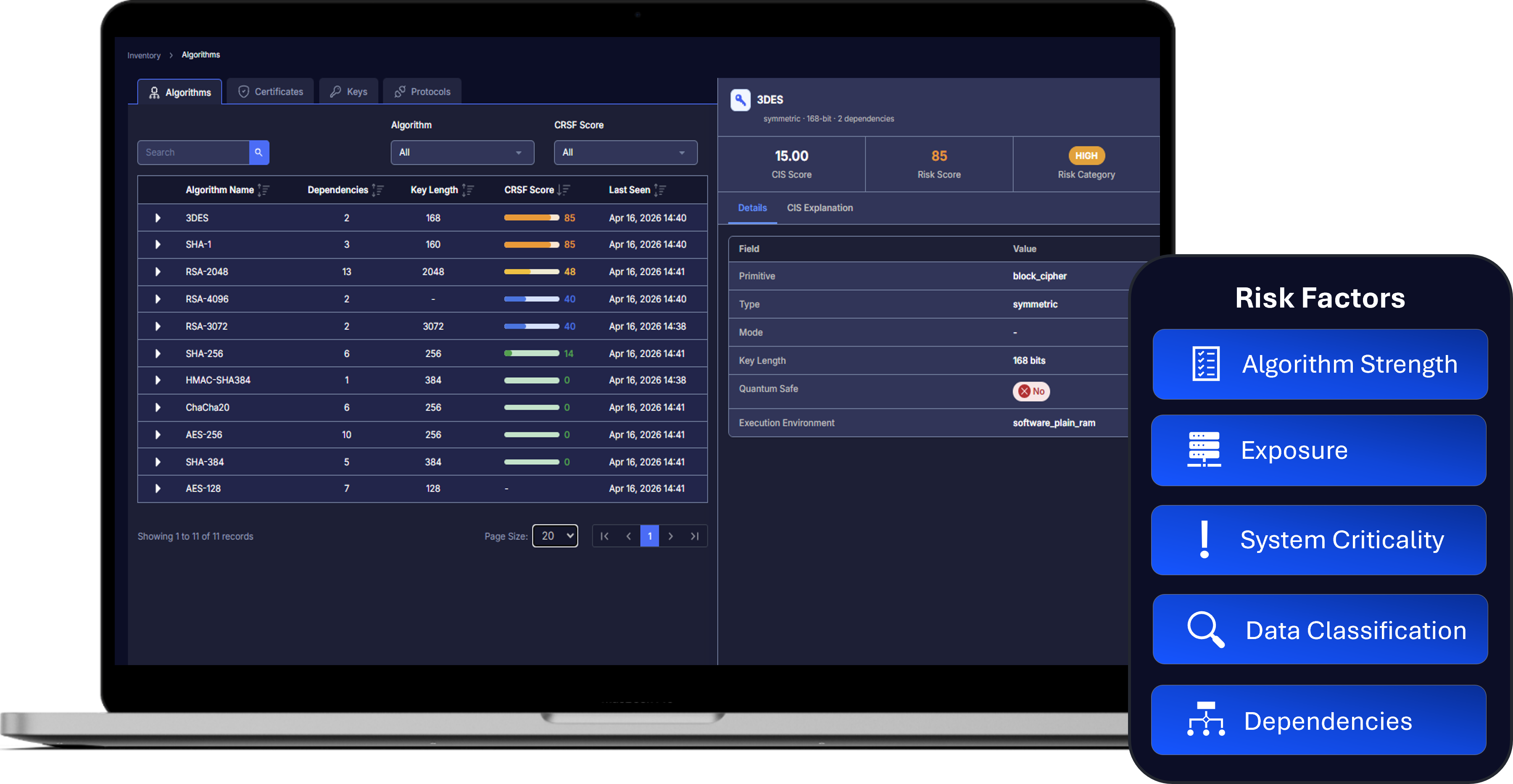
This is the part agencies consistently underestimate. A modern enterprise does not have a clean list of where its cryptography lives. Keys and certificates are scattered across TLS endpoints, code-signing pipelines, PKI, databases, HSMs, and cloud key stores, often with no single system of record. The order's emphasis on high value assets and high impact systems is a prioritization signal: you are not expected to boil the ocean by 2030, you are expected to know which assets carry "high" confidentiality, integrity, or availability impact and move those first. Doing that requires a cryptographic inventory that scores assets by risk rather than just listing them.
Private sector: the FAR rule is the real forcing function
For commercial organizations, the headline is not the agency deadlines. It is Section 6. The order directs the FAR Council to publish, within 180 days, a proposed rule requiring covered federal contractors to comply with NIST's PQC FIPS by December 31, 2030. A second rule, within 270 days, would require contractor vulnerability disclosure programs to incorporate cryptographic vulnerabilities, including testing for missing encryption and the use of non-FIPS-approved algorithms.
If you sell to the federal government, or sell to anyone who does, quantum readiness is becoming a contractual condition rather than a best practice. This is how federal cybersecurity policy has historically reached the private sector: not by regulating everyone directly, but by making compliance a precondition of doing business with the largest buyer in the world. Expect the requirement to propagate down supply chains well ahead of 2030, because prime contractors will push it onto their vendors.
The CBOM provision compounds this. Once CISA defines minimum CBOM elements designed for automated assessment, a cryptographic bill of materials becomes the standard for proving cryptographic posture, the way an SBOM became the expected artifact for software supply chain security. Organizations that can already produce a standards-aligned CBOM will be ready for the disclosure regime. Those that cannot will be scrambling to build inventory capability under a deadline.
Financial services sits at the intersection
Banks and insurers are not federal agencies, but they are critical infrastructure, they are deep in federal supply chains, and they already operate under regulators (OSFI, NYDFS, the PCI Council) that have signaled cryptographic-inventory expectations. EO 14409 directs Sector Risk Management Agencies to help critical infrastructure owners build PQC migration plans, and it tasks the State Department with encouraging foreign governments and industry to adopt NIST-standardized PQC. The regulatory gravity is global and it is pointed in one direction.
For a financial institution, the practical takeaway is that the federal timeline is now a credible anchor for your own. When examiners ask what your PQC migration plan is, "we are monitoring NIST guidance" is a weaker answer this week than it was last week.
What to actually do now
The order rewards organizations that treat this as an inventory-and-prioritization problem first and an algorithm-swap problem second. Concretely:
- Establish a cryptographic system of record. Discover keys, certificates, algorithms, libraries, and protocols across the whole estate, including the surfaces that usually get skipped: HSMs, code-signing infrastructure, and cloud key management.
- Score by risk, not just presence. Identify which assets are quantum-vulnerable, which carry long-lived sensitive data exposed to harvest-now-decrypt-later, and which sit in high-impact systems. Prioritize accordingly.
- Generate a CBOM now. A CycloneDX-format cryptographic bill of materials positions you for the CISA standard and the contractor disclosure rules, and it is the evidence artifact auditors and primes will ask for.
- Assign an owner. The federal model, a single accountable migration lead, is a good one for any enterprise. Cryptographic migration fails when it is everyone's job and no one's responsibility.
The quantum computer the first order envisions may or may not arrive on the administration's timeline. The migration the second order mandates is happening on a fixed calendar regardless. The gap between those two facts is exactly the window organizations have to get their cryptographic house in order, and it is now measured against published dates rather than someone's estimate of Q-Day.
Qinsight builds Atlas, a cryptographic posture management platform that discovers, inventories, and risk-scores cryptography across the enterprise and generates audit-ready CBOMs. If the timelines above map to a problem you are facing, we would be glad to talk.
Next step: Map the applicable requirements to your critical systems, assign an owner, and identify the inventory evidence your team needs. Discuss a defined discovery scope.
Build the evidence behind the argument.
Start with one accredited boundary or one delivered system and produce evidence a reviewer will accept.