Qinsight Cryptographic Posture Management White Paper
Cryptographic posture management (CPM) is the discipline that closes that gap. This paper sets out what a credible practice looks like in 2026: the two clocks every enterprise is on, the dated schedule that now governs planning, five principles that separate a posture program from an inventory project, a readiness ladder for negotiated protocols that tells you whether a post-quantum control is real, and a way to measure progress that is built for audit, regulatory and board review. It closes with a short account of how Qinsight builds for this model and a ninety-day way to begin.
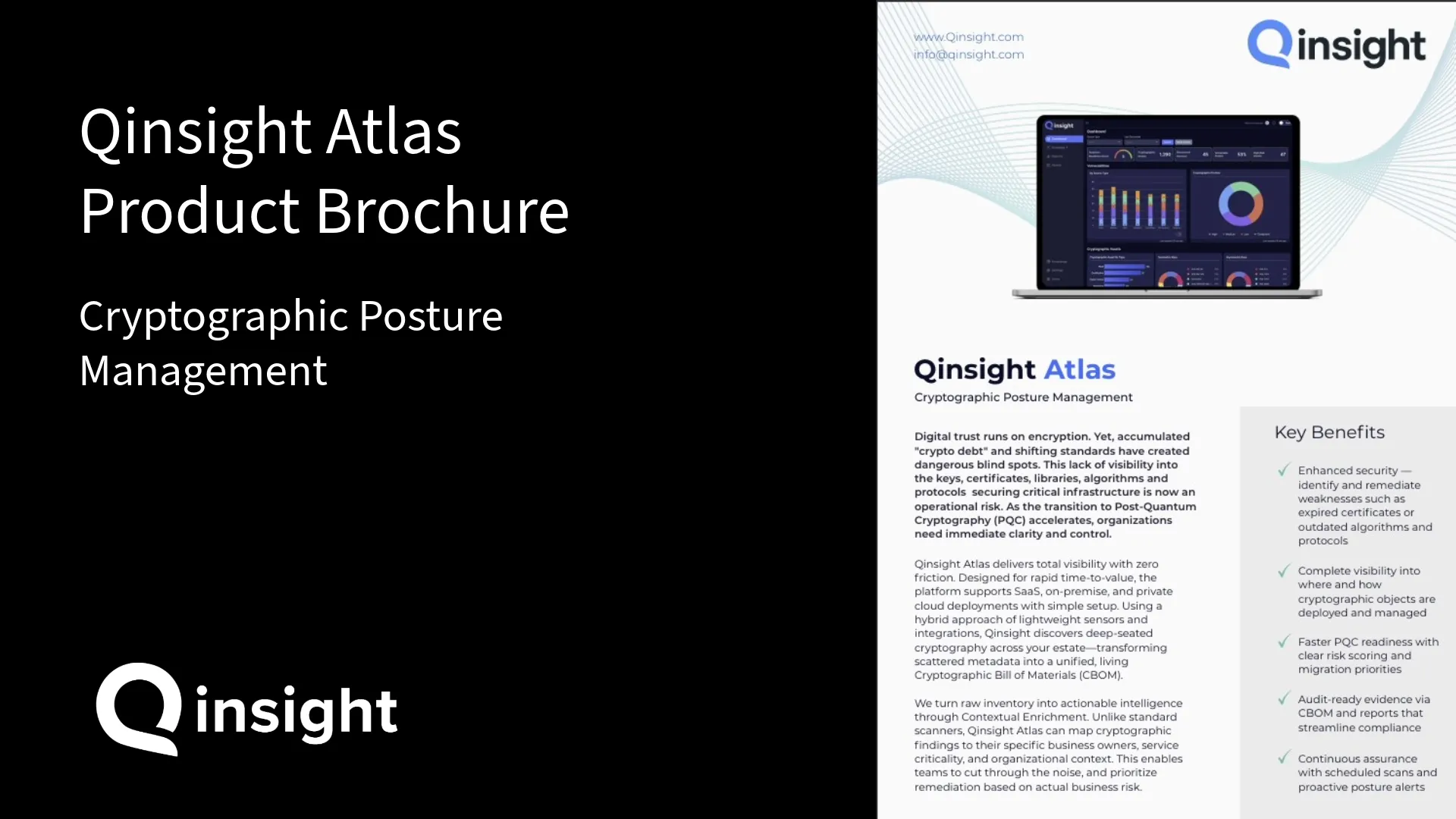
Qinsight Atlas is a cryptographic posture management platform designed around evidence. It discovers cryptography across networks, cloud key services, databases, code repositories, vaults, hardware security modules and supported security platforms through scheduled or on-demand scanning and credentialed read-only integrations with supported third-party systems. It imports CycloneDX CBOMs, and in scoped or controlled evaluations it can import customer-supplied packet captures, so that supplier declarations and observed behavior can be compared in one place. Every observation is retained with its provenance, then normalized into a relationship graph that connects certificates, keys, algorithms and protocols to the endpoints, applications and assets that depend on them, with business context from the customer’s CMDB where a supported integration is enabled. The record is portable by design. Atlas works alongside PKI, HSM and remediation platforms rather than in place of them: it integrates with supported third-party systems, exports in open formats, and the evidence goes to whichever auditor, regulator or remediation partner the customer chooses. Prioritization is explainable at the level of the individual finding: the observed condition, its classical and post-quantum relevance, the context available, and the context that is missing. Atlas is also clear about what it does not do. Discovery is scheduled or on demand, not continuous passive monitoring. It never extracts private keys or decrypts application traffic. It does not rotate keys, replace certificates or change infrastructure, and it does not certify compliance. Configurable policy evaluation and workflow handoff are being expanded and are described to customers as such. In the language of this paper, Atlas helps organizations progress from stage 0 toward stages 1 and 2, and supplies the evidence that stage 3 governance depends on.
Subscribe to our weekly newsletter
Receive weekly insights on cryptographic risks, emerging security standards and quantum readiness.